Roadkill
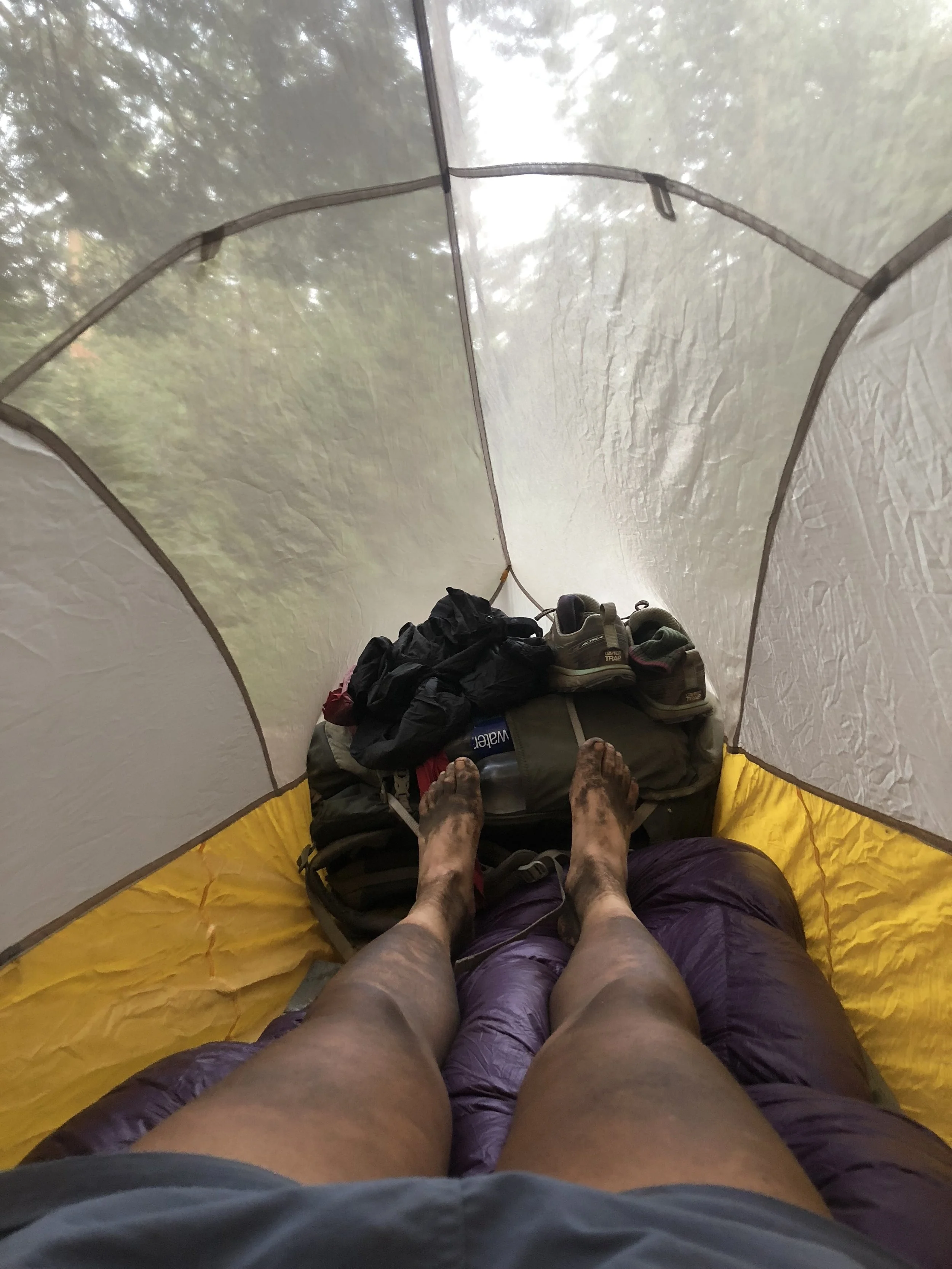
Photo by me
Seven hundred miles into a northbound thru-hike of the Pacific Crest Trail, you reach one of the more coveted and well-documented moments of the trail system. Kennedy Meadows marks where the desert ends and the High Sierra begins. This is where you collect your mandated bear canister, eat your body weight in pancakes at Grumpy Bear’s, and shoot the shit with your new friends as you strategize how to approach the next couple hundred miles. It’s a time to welcome broad, breezy meadows and sources of water that don’t have uranium in them.
In June of 2018, I sat picking at my share of pancakes—an island of Brown femininity in a sea of decidedly ultra-light, white outdoorsmen. A cloud of exhaustion from days of nauseous desert hiking in the baking hundred-degree heat separated me from their endless talk of gear and beer. Unable to best even two full pancakes, I was beginning to wonder: What the fuck am I doing here?
While I’d been recovering at Kennedy Meadows for two days, I knew that my current state wasn’t the only thing separating me from my hiking peers. I seemed to lack the careless or carefree gall of many of my comrades. I’d started thru-hiking as an outdoors newcomer relying on my dancer’s legs to propel me along the trail. I had been enticed by the romantic promise of solitude, beauty, adventure, physical challenge, and a chance to explore my home state of California. Now here I was, four weeks in, hiking thirty-mile days and running away from a perpetual stream of northbound men, all in the hopes of finding that freedom. God forbid I would have to pass the same person twice.
I mitigated my isolation by surrounding myself with a choice few of these men—all amusing late-start speedsters. With them came a feeling of safety and a superficial sense that I was in with “real” outdoorsy people. Through the miles, we became each other’s makeshift support. I aimed to play the role of future “lifelong friend,” which everyone knows is an integral part of the thru-hiking experience. Every time I tried to remind myself that my goal was to hike to Canada and that the social aspect was extracurricular, I was thwarted. The PCT was more social than I had anticipated. My attempts to masquerade as an outdoorsy person only made me feel more at odds with the other hikers.
Physically, my body was holding up well to trail life. I cried a lot those first 700 miles, but not a single tear was from a blister. I cried when I plugged in my headphones for the first time after a knee-grinding ten-mile descent and music sounded extra-sweet; I cried feeling alone in my tent at night; I cried when, at the end of a long day, I had to run away from a swarm of bees and a sunning rattlesnake blocked my path to freedom; I cried when I puked for 100 miles in the desert. Generally, these were all acceptable cries.
My first unacceptable cry was walking toward me and my half-eaten pancakes at that table at Grumpy Bear’s. As a solo thru-hiker, I’d been pink-blazed (trail-followed and trail-courted) for hundreds of miles, but Caesar Salad was, unfortunately, my first trail romance. Three hundred miles ago, a misguided gut feeling had led to thirty seconds of disappointing sex, at the end of which he came on my freshly laundered shirt and threw it at me, right before I was meant to head back on trail. I had wanted to rip him apart right then. And again, soon after, when he only maybe jokingly called me “exotic.” And then also when his East Coast ass said, “I don’t get what the hype is about burritos”—in a family-owned Mexican restaurant in Southern California. Ignoring my misgivings, I let this fool plop his pack down across the table from me.
“There are so many different kinds of people on trail.”
After a moment’s consideration, I said, “Um, I guess this is maybe a diverse group of white people.” Nearly everyone I had met so far fit the same generic thru-hiker description.
“I mean I think this is just a diverse group of people. There are so many people from different countries.”
“I don’t see anyone here who looks like me.”
“Well, I just think Black and Brown people are really, really lazy.” He looked me dead in the eye, nothing but brazen self-assuredness to back up his claim. “That’s why you never see them outside. I talk about this all the time with my family, but it’s like you never really see them doing anything physical or trying to explore nature, and I think it’s because they are just lazy.”
Now, I was no stranger to rich white people recreating outside in ways that immigrants, the poor, and BIPOC in the USA would never even consider, but I had never heard such blatant white ownership of the outdoors in casual conversation. Did his my-parents-paid-my-way-through-grad-school ass just say that skin color and laziness were linked? Why would he say that to me?
At this point, two of my other man friends in short shorts sat down at the adjacent table and started listening in. I was about to rip this motherfucker’s head off for his incredible ignorance, and I was happy to have two witnesses to vent with later.
“Wait, what are you talking about?” my two dudes chimed in.
“Well, Caesar Salad here was just saying you never see Black and Brown people on trail because they are lazy,” I explained, ready to finish this man. “I don’t think he realizes that Black and Brown people are also the ones more likely to be working with their hands and working outside, both historically and today, both here and all over the world. If you and your family spent all day working outside in a field or on other people’s land, why would you want to spend your leisure time pretending you are poor, getting dirty, being in physical pain, and walking two thousand miles for shits and giggles. That’s not ‘fun,’ that’s just their fucking life. Not everyone can afford to eat-pray-love their way to finding themselves outside.”
The seconds dragged as silence rang on. My voice had remained steady, but my hands were trembling.
“That’s interesting, thank you for sharing your take on it, and I’m sure there are many sides to that conversation.” An indictment from one of my blond-haired, blue-eyed friends.
My brain glitched as the conversation teetered ungracefully to other subjects. I gnashed my teeth in silence for a moment longer before pushing my chair back and wandering to my tent in the yard. There, I had my first real messy cry on the PCT. I want to say I cried at the social injustice and went back to the trail spreading a decolonizing gospel. But my tears were entirely personal. I was really crying because I wasn’t a tall pale man whose dad taught me how to pitch a tent and make a fire, and in that moment, it fucking sucked. I came out here to challenge myself, and now if I didn’t fully hike this trail, I knew at least a few people would think I was a lazy failure, representative of the lazy failure of all melanated peoples.
My tears were made of anger, too, not just sadness. I was pissed that the outdoors could not be a reprieve for me, just one more place where I would have to work harder than everyone around me to prove my worth. I was pissed that I would have to mold myself to yet another social script.
First, I would whitewash myself—feigning interest in mountain worship, boozy nights, country songs, burgers, and saying “howdy.” Then, I would mute myself as I passed through small-town America. I would wear apoliticization like a shield around other hikers and the gun-toting, Jesus-fearing townsfolk. Despite vastly different politics, both groups seemed to get along with each other on the basis of whiteness alone. I didn’t have that privilege.
Next, I learned about the perceived weaknesses of my femininity. In the endless gear chatter, I was rarely, if ever, asked for my opinion. I was thought of as slow, even when I was fast. I quietly ignored men who hiked behind me, openly staring at my ass. Most annoyingly, I was still expected to care for the physical and emotional needs of everyone around me. And I had to look and smell cute doing it.
White women I passed on trail seemed to feel some of these things too. They sometimes fought for “other” people because they were also “other,” but eventually, they hit their groove. There were other white women who could show them how. My choices for navigating the social script felt more limited. I was never going to fully feel a part of things, and I never did find another person who looked like me on the PCT.
As I lay in my tent that night, mulling over these thoughts, I half-considered departing from Kennedy Meadows and walking into the Sierra then and there. I wondered if I was using a too-close magnifying lens on social politics and identity. Maybe I was too affected by my surroundings and unwilling to just show up and send it, hike my own hike, and have a happy trail. Very Gen Z of me.
The next day, I practically bolted out of Kennedy Meadows, a full day ahead of my trail family, determined to keep going and to go on my own. Miles over smiles became the antidote to the social intricacies of trail. Fuck if I was lazy, I was going to get to the end first. I didn’t want to sit around and eat and drink in town. I wanted to see what I was made of, and I wanted to go harder, better, faster, stronger than the rest of them.
As I wound through the high passes of the Sierra and on to the rest of the trail, however, the tears still came, and I found myself code-switching to match the trail.
I cried in Chester, California, the midpoint of the trail. I was sleeping at a church, one of two women in a large group of men. Some of those men started talking, with profound obscenity and degradation, about whether they would rather be fucking white or black pussy. No one told them to stop. I didn’t feel safe enough to.
I cried out of tired frustration on the side of a fast, deep river crossing. All the long-legged, risk-taking men happily skipped over the wet rocks. I cried again with laughter and joy after one of my femme friends came up behind me, and together we rolled boulders down the steep banks to create our own river crossing.
I cried during my first forty- and fifty-mile days. I peppered these big days between my usual thirty-milers to beat boredom and to prove that I had a place outside.
I cried on my first sixty-mile day in ninety-seven-degree heat, on the second day of my period. I threw up 3,000 calories of milk products from town and rolled my ankle on volcanic rock. I would feel the effects of that day for the next 1,000 miles.
I cried numerous times my last four days on trail, when I was taking twelve Advil per day to hike with an injured Achilles, just to get to the finish line.
I cried when I didn’t know how to fix my tent pole, and realized I was dependent on the men I was hiking with to help me. I cried out of gratitude for the men I was hiking with when they helped me.
I cried in gratitude for everyone I hiked with and all of the laughter they provided, the long downhills we skipped and ran together, and the binge eating that bonded us in town.
I didn’t, however, cry when I reached the northern terminus. I didn’t even care. Objectively, I had emerged successful in this experience. I wasn’t one of the lazy ones. I had achieved something in the grand world of outdoor recreation. There were hundreds of cute outdoor influencers posting their version of this moment, feeling that it was the greatest achievement of their life. If they had done something, I had probably done something too. That I didn’t care about the achievement didn’t matter. That I was bored for months of trail didn’t matter. Neither the macro-view nor the micro-view of the trail mattered, so long as I put one foot forward and completed my goal, or so I was told.
The only thing that seemed to break through my apathy was that I had made it as an outsider in a space I didn’t belong. I had planted myself in the thru-hiking community in spite of my own and others’ assessments of my abilities. I had given those expectations the middle finger and proved them all wrong. That felt good.
The achievement of it all caught up to me when I realized that I could be the first South Asian person to Triple Crown, completing all three long-distance trails in the US. It didn’t take me long to start fantasizing about the PCT’s longer, harder cousin, the Continental Divide Trail. Post-COVID, in a changed world, I would attempt the CDT.
I would start in July and hike southbound, through hard miles in Glacier National Park and the Bob Marshall Wilderness. From there, it would be a race against the cold to Colorado. I was more experienced in the outdoors, but I had never decided that I actually liked thru-hiking. Even before arriving at the northern terminus of the CDT, I was worried about entering back into that world. Spending the pandemic in Colorado Springs only served to ramp up my social anxiety and racial fatigue. I didn’t know if I was ready to enter into a space where I had to act like I could conquer all nature and disregard the people living in the places I passed. Plus, eight close-range black bear and mountain lion sightings on the PCT had proved that animals loved me, and I didn’t want to meet too many grizzly bears.
On the other hand, I was starting to see more opportunities for BIPOC hikers on social media. I was curious to see whether, in this changing landscape, I would finally find my place on the trail.
***
I landed in Kalispell, Montana, with another thru-hiking friend, ready for four hours of hitchhiking to the Canadian border. Again, I was the only Brown person in sight. On my third hitch, the driver of an “om”-adorned, but otherwise clinical RV began telling me all about how he loves Indian people, especially his spiritual Indian yogi girlfriend/mistress. They’d spent many nights together in the bed I was sitting on. I lasted under three weeks on the CDT.
I cried on the first day, when I met a woman with long, dark hair and medium-brown skin. I said to her, “Wow, I’m so excited to meet you, I did not expect to see another Brown person out here, I’ve never met another Brown person on trail!” And she said, “Neither have I, especially on day one.” We spent the night camping together. I thought that meeting her first must signify some change in the hiking demographic. In 2023, she would go on to finish her Triple Crown.
That night, we were camped out by a lake in Glacier National Park when we met two old Montana cowboys. After “watering their horses” in the lake, the cowboys got to drinking and guffawing. They yelled out to our group of hikers, “Hey! What’s all y’alls name?” When I said “Ankita,” I hoped they’d just gloss over it and not spend too much time asking what it is and where it is from. Unsurprisingly, one went, “Anika, or did she say Anita? I’m just going to call her Anita.” Classic. I hoped they would move on. Instead, the other said, “No, man, that’s racist! You can’t just call her that!” His friend responded, “Well, I ain’t tryna be racist, I just don’t know what her name is!” So they continued laughing, and I started laughing too. I laughed so hard I cried.
I also cried one night in my tent after sitting around a fire in a large hiker bubble. The other hikers were making fun of the fact that they were all white guys with beards, wearing the same thing. But then they talked about how sad it was that there was no diversity on trail. That started a long conversation about how to get more people involved outside. No one said anything about laziness then. There was nothing but care.
Another time, someone asked about my trail name, Roadkill. I launched into the story of how I got it: some man terrorizing PCT hikers threw a machete at me in the Angeles National Forest. Normally people are surprised and impressed by that story, but this time everyone just looked at me in silence. Someone finally whispered, “I’m sorry you were assaulted on trail.”
My biggest tears on the CDT, however, came in Lincoln, Montana. I spent my zero day listening to music at a biker rally, being shown guns by the local townspeople, and looking at “tipi burners” at Blackfoot Pathways—a sculpture park in the name of the Blackfeet Nation that was filled with only white-made art. That was enough.
Lincoln was where I chose to leave the CDT. I was tired. I didn’t care about reaching Mexico, or even Wyoming. Dreams of a Triple Crown felt distant. Unlike on the PCT, my miles stopped when I stopped smiling. Hiking across arbitrary state lines felt less monumental than ever before, and any perceived burden of shouldering representation outside didn’t feel worth it.
In some ways, leaving the CDT felt like freedom. It would have been impossible for me to feel good about the accomplishment, and it felt good for me to abandon the attempt. I don’t think that acquisition is meant for the land, and I don’t think it is how I want to experience this country—like I am racing against time, needing to seize more and more of it. I don’t think it’s brave to be walking trails on stolen land, like we aren’t all imparting traces of harm for fun or accomplishment or peace or whatever our gain is. The little hurts and microaggressions, sometimes macroaggressions, of the trail feel reflective of how we treat our planet and people.
At the same time, the social fabric of the CDT made me hopeful. The white people were starting to get it. Being a Brown person outside meant something, even if just on an interpersonal level, and that did not need to be proved. Problems with outdoor inaccessibility did not need to be proved. Enjoyment of landscapes and seasons and novelty as a shared resource—that did not need to be proved. And, in celebration of these new facts alone, I’ll still take a long hike. But as I climb, spend time with wildlife, sharpen my homesteading skills, and make environmental art, I find that my own relationship with recreating is finally meandering outside lines.
This personal essay was first published in the anthology Blood, Sweat, Tears, compiled and created by Christine Reed.